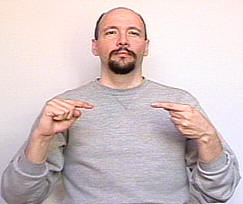
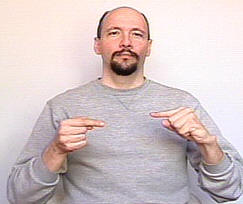
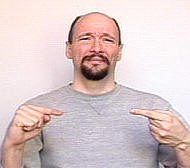
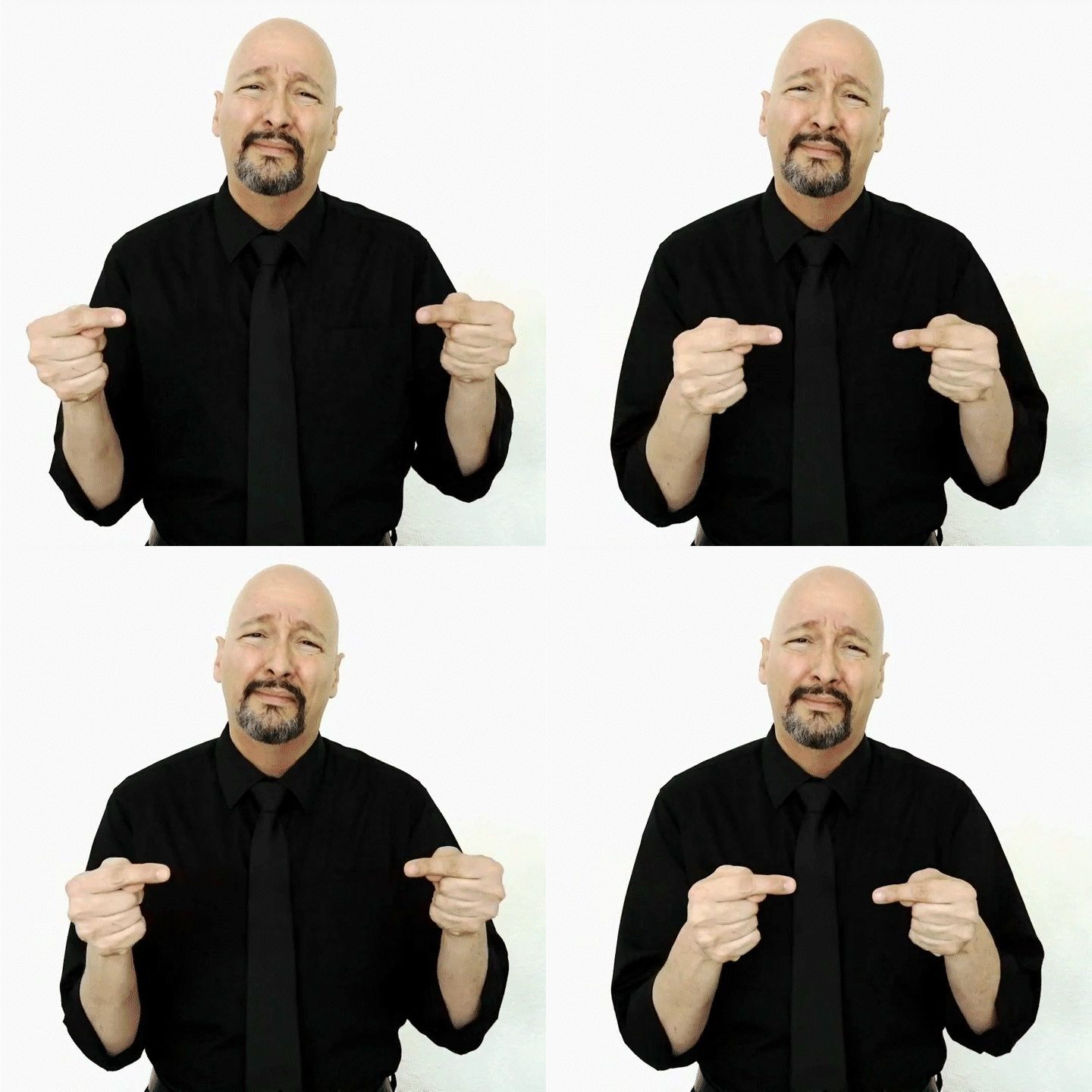
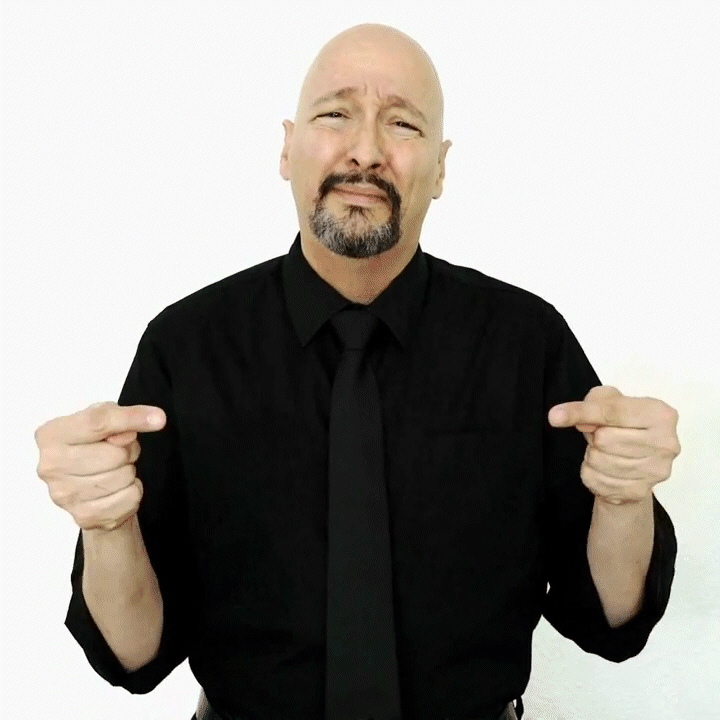
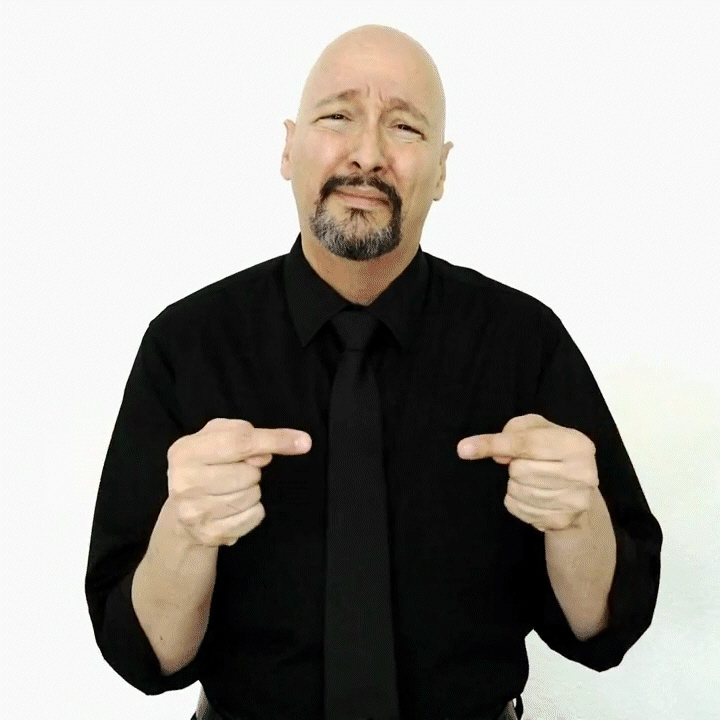
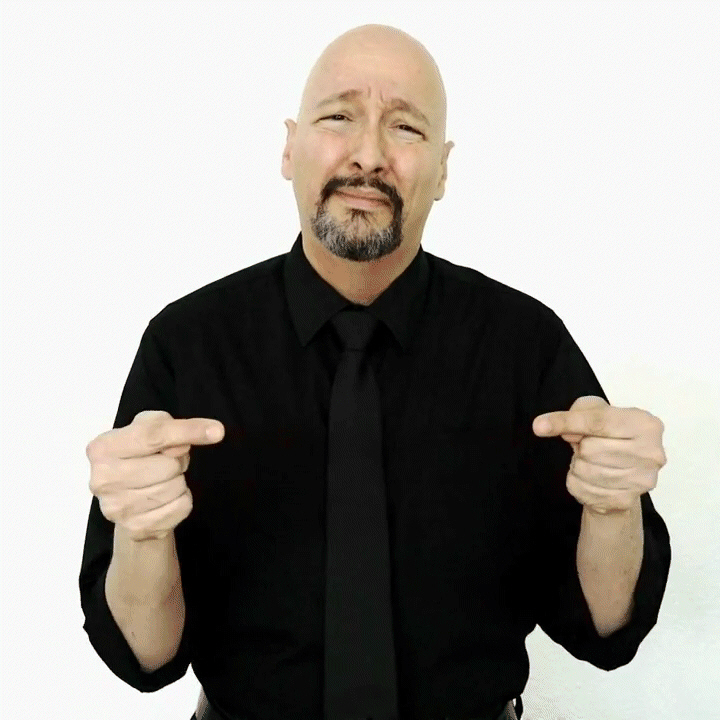
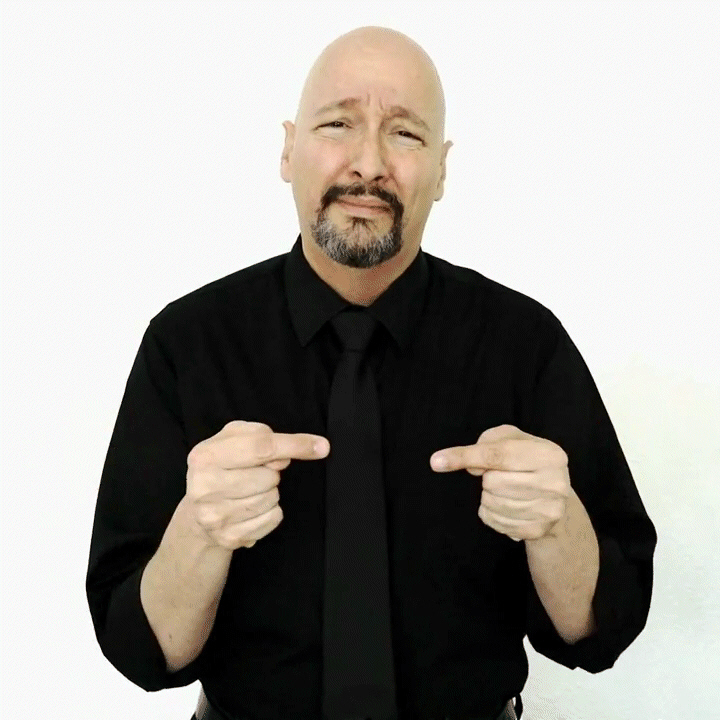
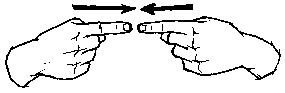
The sign for "hurt" is made by extending
the index fingers of both hands. Bring the fingers toward each other twice
using a jabbing movement.
A variation of this sign is to do a twisting movement as
you bring the tips of the index fingers toward each other. The right hand twists
one way and the left hand twists the other.
Note: Both versions of the sign for "HURT / PAIN" can be
done on or near the part of the body that is feeling pain. For example if
you have a toothache, you can indicate that in one sign by doing the sign "hurt"
near the side of your jaw. If you have a headache, you can indicate it by
signing "hurt" near your forehead. Personally, for a general headache
or toothache I use the double jab movement. But if it is a "killer"
headache I do a single strong twist of each hand simultaneously.
Version 1 of the sign for hurt uses a twisting
movement. This sign is good for concepts like "injured."
HURT / PAIN Version 1:
Memory aid: "Sticking two knives into your ribs and twisting them would hurt
eh?"
Remember, USE FACIAL EXPRESSION with this sign. The more it hurts, the more
facial contortions.
ASL is a language that depends heavily on facial expressions. If
you are in "SERIOUS PAIN" then you need to show it on your face.
Version: HURT / pain
/ throbbing / aching
Use a double jabbing movement.
Optional / Advanced discussion:
(Not needed for class)
In a message dated 10/31/2007 9:23:20 A.M. Pacific Daylight Time,
lalaliv314@ writes:
If the sign for pain/hurt can be signed over the body part that's
hurting, how would you indicate that your hand or finger(s) hurt?
Thank you very much,
°Kami
Kami,
Hey, that is a clever question!
Lucky you -- I've got a clever answer:
The concept of "hurt" is quite often expressed by spelling the word "hurt"
very quickly near the location of the pain. The spelling of "hurt" can
actually take the form of "lexicalized fingerspelling." (Check out the
topic of lexicalized
fingerspelling at the Lifeprint.com library.) When used at the
location of the pain this sign is also considered to be a "locative" sign.
In response to your question about "how would you indicate that your hand or
finger(s) hurt?" -- I'd do the sign for "hands" and then sign "pain." Or if
it was a specific point on my hand I'd point to it and sign "pain." If it
were my "left" elbow, I'd point at it and then sign PAIN. Or I
might point at it and then spell "hurt" (as a lexicalized
version) near the elbow, while using appropriate facial expression.
Cordially,
Dr. Bill
A student writes:
...I have a question about another way to sign hurt. I've seen hurt signed
the same way as shown on the website, but I've also seen it signed like that
with two fingers (the index and "middle" finger). Is that a correct way to
sign hurt?
- Dennis Sanche
9th Grade
Dennis,
Using two fingers on each hand to sign "hurt" is not standard in the
Deaf Community. Rather it is a version of signing that is called "Signed
English." The version you are asking about is obviously intended to
represent the English word "hurt" by doing the ASL sign "HURT" using the
letter "H" handshape.
Thus if you are attempting to sign English or taking a Signed English
test then no that version isn't wrong.
However, if your goal is to eventually sign like native Deaf adults do
and/or pass an ASL test then I'd recommend you stick with the
non-initialized version of "HURT."
Cordially,
Dr. Vicars
Want to help support
ASL University? It's easy:
DONATE (Thanks!)
(You don't need a PayPal account. Just look for the credit card
logos and click continue.)
Another way to help is to buy something from the ASLU "Bookstore."
Want even more ASL resources? Visit the "ASL Training Center!" (Subscription
Extension of ASLU)
CHECK IT OUT >
Bandwidth slow? Check out "ASLUniversity.com" (a
free mirror of
Lifeprint.com less traffic, fast access)
VISIT >


 The sign for "hurt" is made by extending
the index fingers of both hands. Bring the fingers toward each other twice
using a jabbing movement.
The sign for "hurt" is made by extending
the index fingers of both hands. Bring the fingers toward each other twice
using a jabbing movement.